|

EDITORIAL
by TERRY SIEGEL
I have been writing and answering
questions about keeping both large and pigmy angelfish in reef tanks for
at least 10 years, and it is a topic that continues to interest reef
keepers. During that period I have kept quite a selection in my reef
tanks, and furthermore have been in contact with other reef keepers who
have shared their experience with me concerning the advisability of
keeping angelfish in reef tanks. The short answer to this question is that
if you are unwilling to take any chance that an angelfish will eat one of
more of your invertebrates than keep them out of your reef tank. If you
are more adventuresome, as I am, then read on.
|
Currently, in my 10-foot reef
tank I have two angelfish: an adult Pomacanthus navarchus,
and one adult Centropyge loricula.
The P. navarchus was purchased
as a juvenile and, over the last 10 years, has grown to about 8 inches and
has adult coloration. The C.
loricula has only been with me for about two years. Both angelfish
will on occasion pick at SPS corals (small polyp scleractinian), but I
have never observed either doing any damage to these SPS corals. Neither
works for long at a specific section of an SPS coral, which is evidently
why no damage is done. In my experience and those reef keepers that I know
of this behavior is typical of almost all angelfish in captive reef
systems. I don’t know of an angelfish that has done serious damage to an
SPS coral.
However,
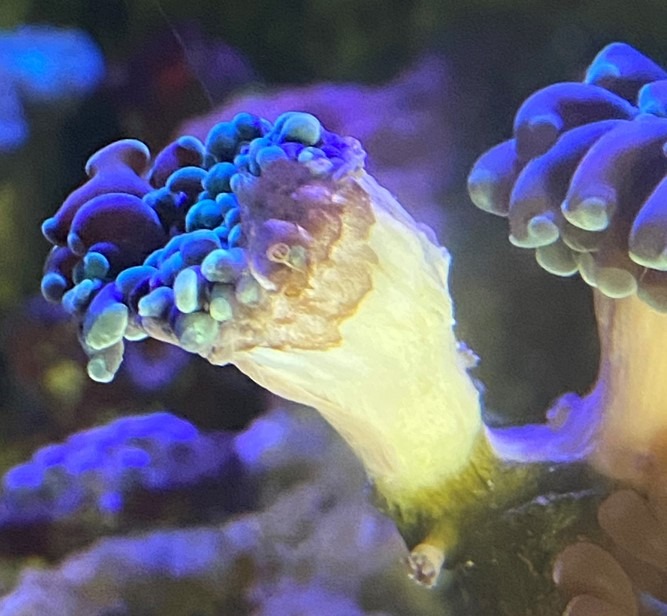
when it comes to LPS (large polyp scleractinian) corals unfortunately the
situation is quite different. Some corals with large fleshy polyps – Turbinaria
spp., Trachyphyllia spp., Wellsophyllia
spp. Cynarina spp, etc. –
are often targeted by large angelfish. These corals will try to protect
themselves by withdrawing as much of their tissue into their skeletons as
possible, but many large angelfish will work at them until they are
destroyed or seriously damaged. It should be noted that there are many LPS
corals whose taste and or nematocysts are disagreeable enough that they
are left alone by large angelfish. I am not familiar with one instance
where an angelfish of any size went after a Catalaphyllia
jardinei or any Euphyllia
spp. However, it is important to note that one can never predict what a
specific fish may or may not do.
|
|

|
| This photo taken
in the author’s reef tank in July of this year shows
many of the tank’s fish, including Pomacanthus navarchus,
assembling near the feeding area. |
|
|

|
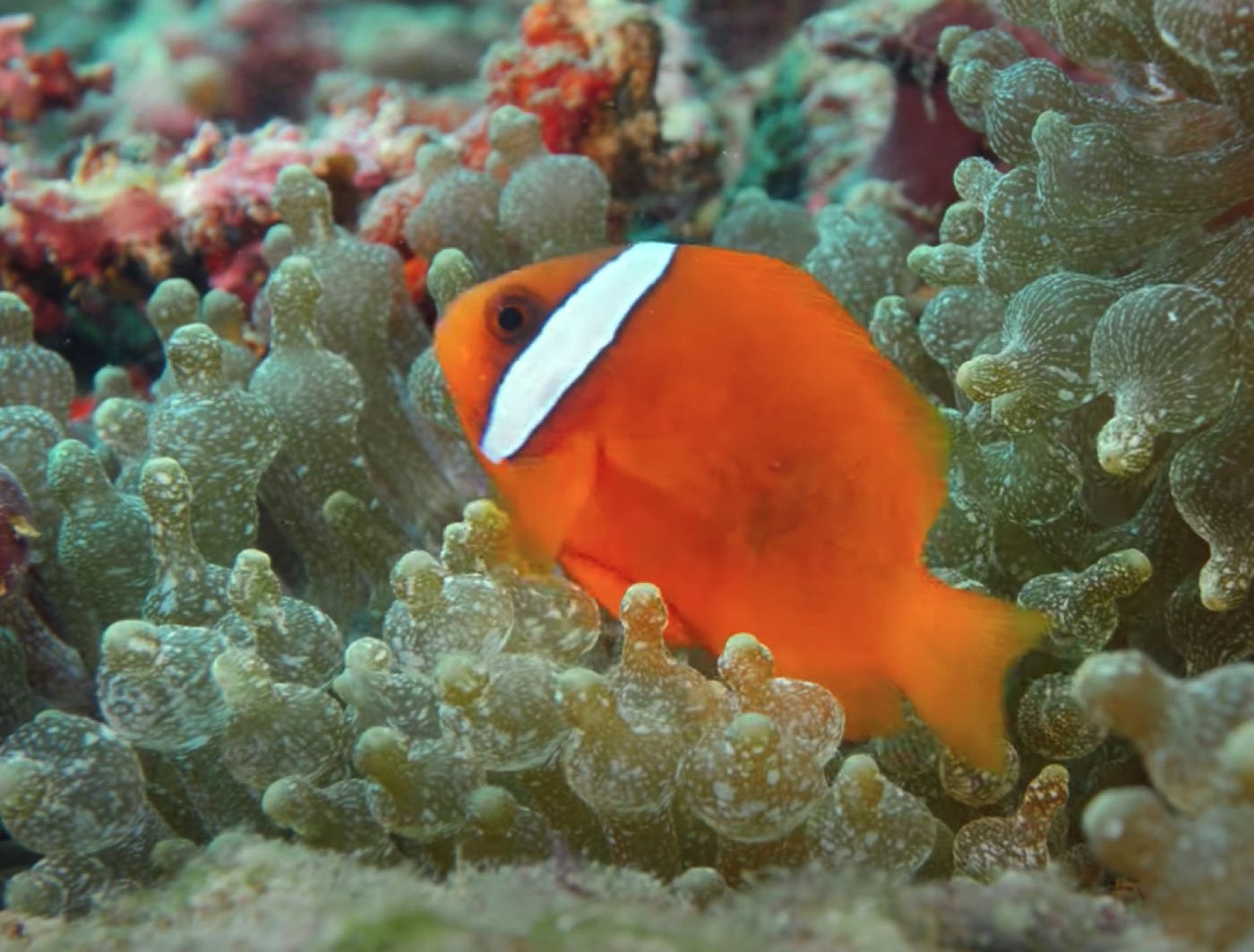
| A. frenatus
guarding its home (a E. ancora) and inadvertently
protecting a small patch of Anemonia magano from
my P. navarchus. |
|
When
it comes to soft corals and anemones we are pretty much in the
same boat. Many soft corals like Zenia
spp. appear to be regarded as delicacies by many large angelfish
and even to some of the pygmy angelfish. If your reef tank is
dominated by soft corals keep angelfish out of it. However, there
are many soft corals that are too poisoness to taste good to
angelfish: virtually all of the larger members of the subclass
Corallimorpharia – Discosoma
spp., Palythoa spp., Rhodactis
spp. – are avoided by angelfish. On the other hand, smaller
anemones are often eaten by at least the larger angelfish – Aiptasia
spp. and Anemonia spp.
for example. Like some of the butterfly fish, some large angelfish
will eat these smaller anemones, much to the delight of reef
keepers. Left unchecked the two just mentioned small anemones can
over-grow a reef tank, forcing its owner to break it down and to
start all over -- not a pleasant prospect. Aiptasia spp. can easily be eliminated with shrimp, nudibranchs, or
butterfly fish that prey on them. However, eliminating Anemonia spp. is much more difficult. With this fast growing anemone
the reef keeper has to rely, at least at present, on certain fish
to feed on them. I should note here that they can be removed
manually by injecting them with hot Kalkwasser or acid, but this
is only if you have a few. The problem is that the fish (raccoon
butterfly fish and certain large angelfish) that prey on them will
also prey on animals that reef keeper’s prize. |
As
can be seen from the photograph, in my ten foot reef tank I have a small
patch of the nuisance Anemonia.
The patch is in front of my 17 year old Euphyllia
ancora, which has grown from a
small fragment to an animal that is 24 by 23 inches in size. Many years
ago, after the E. ancora was
added to an older reef tank – my first -- my now 19 year old Amphiprion
frenatus made it her home. From that time on, in true anemonefish
fashion, it has protected its home from all comers. In my current tank
there is not one Anemonia sp. anywhere accept that small patch. My P. navarchus eats any it can get at. So, the patch is protected by
the anemonefish. In fact, my old crusty A.
frenatus, once took a sizable chunk out of my angelfish’s tail when
it got too close.
Years
ago I had a P.asfur in a reef
tank with a large colony of Xenia
spp., which for over a year it did not go near. Suddenly, it developed a
taste for Xenia, and wiped out the colony in a few days. With large
angelfish in a reef tank you are taking a chance. I would, however,
suggest that to my knowledge the regal angelfish (Pygoplites
diacanthus), kept by a number of aquarists in reef tanks has so far
worked out well. Nevertheless, ounce again, one can never completely
predict the behavior of any individual fish.
Perhaps
the safest group of angelfish for the reef tank is Genicanthus
spp. These angelfish are generally planktivores, but even here I know of
one male Genicanthus lamarck
that went after SPS corals. The so-called pygmy angelfish (Centropyge spp.) are kept in many reef tanks, but not always with
the best results. Although they rarely bother corals enough to damage them
seriously, some individuals will pick at the mantel of Tridacna spp. clams, causing the clam to close, which can lead to
its death, if the fish is persistent enough.
Recently,
an experienced reef keeper wrote:
“I've
tried 14 distinct species of Centropyge,
and none of them were 100% reef safe. And for what it’s worth, they are
more often then not impossible to catch once introduced. So the bottom
line is I wouldn't again. (I am rather stubborn and stupid; it would seem
that 14 attempts are enough to learn a lesson!)”
|
Despite this reef keeper’s
experience I currently have one P.
Navarchus and one Centropyge
loricula. The pygmy angelfish has not bothered anything, including
my clams, and the navarchus is more of a help than a nuisance, but I cannot keep
certain fleshy corals in with it. For me, this is an acceptable
trade-off. The P. navarchus
is a beautiful fish.
One of the most gratifying
developments which has come with the publication of our Advanced
Aquarist online magazine is the interest it has engendered in
countries outside of the United States. The international sharing of
information, leading to an international community of aquarists, is
one of the hopeful things brought about by the internet. The sharing
of humankind’s fascination and caring for living things on our
planet can only bring positive results. This month’s Featured
Aquarium is a case in point.
|

|
To access our Editorial forum, click here
Copyright 2002 Advanced Aquarist's Online
Magazine |
|