Captive husbandry of Goniopora, spp. with remarks about the similar genus Alveopora
Goniopora
spp. "daisy" or "flowerpot" corals have been common
imports from Indonesia and other coral collecting regions since the
early years of the reef-keeping hobby. Alveopora
spp. are less-frequently harvested relatives of Goniopora
spp. These distinct genera are often grouped together by aquarists
because they have similarly elongate polyps with daisy-like heads.
However,
the petal-like tentacles in Goniopora
number 24; in Alveopora there
are just 12. These corals are among a small group of hermatypes that
have both charmed and frustrated aquarists for years. I too have
experienced the agony of failure with these corals but, more recently,
have had quite reproducible and gratifying success with Alveopora,
and several species of Goniopora.
In my opinion, it is wrong to generalize that all "Goniopora" are difficult to keep. There are numerous species,
and they behave differently in captivity. I reported (Sprung, 1999a,
Sprung 1999b) that certain species of Goniopora
are easy to keep, contrary to popular belief, and that most Alveopora
are similarly hardy.
Long-term
success is reportedly rare in Goniopora
stokesi, the most commonly harvested species for the aquarium trade,
and the loss of the coral usually occurs slowly, as a sort of wasting
condition. Some other Goniopora species are likewise difficult to maintain for apparently
the same reason, but there are some species that do not usually suffer
the same wasting condition. These "easy Gonioporas"
are the ones with which I have had long-term success, in excess of five
years. More recently I have been working on Goniopora
stokesi. I believe I have discovered what it needs to prevent and
cure the wasting condition, and why it occurs, but before I explain
that, I want to review the state of opinion among aquarists concerning
the genus.
The
aquarium literature concerning the difficulties with these corals
as well as discussions among aquarists about them seem to focus on
issues of water quality, light, and food. The accumulation of
nitrate and phosphate, the maintenance of calcium and alkalinity
in closed system aquariums, and a "missing magic
ingredient" have been the focus of numerous "fishy"
theories concerning the demise of these corals (see Ates, 1997,
Wilkens, 1990, and Sprung and Delbeek, 1994). Additionally there
was a study launched by Mary Middlebrook and apparently not yet
completed regarding the possibility that Goniopora
stokesi fared better when maintained in groups, with adjacent
colonies in contact with each other. Subsequent to my publication
of an article describing my ideas about coral bleaching and Goniopora
stokesi (Sprung, 1999a), there were discussions on the
internet and an articles published in response (Toonen, 1999a and
Toonen, 2001) suggesting that Goniopora
(again, in the general sense) required more food. Many aquarists
want to believe that the syndrome affecting Goniopora
is really just starvation. I don't believe it is. Nevertheless, Goniopora
species do feed, and at least one study suggests the feeding is
essential for their survival (Toonen 1999a and Toonen, 2001).
Proud sponsor of this column
Goniopora fruticosa photographed on a reef slope in the Solomon Islands. This is a distinctive species. Other species are more easily confused.
Adding
credence to the "missing ingredient" theories, a
columnar Goniopora
species maintained at the Waikiki Aquarium has thrived and grown
enormously... for many years, under natural sunlight in an
open-system aquarium using seawater supplied through a well. By
contrast, when aquarists at the aquarium attempted to maintain
cuttings of this species in a closed system with artificial
light, they had the typical experience of a slow decline in
polyp expansion. To prevent eventual loss of the colonies the
fragments were returned to an outdoor open system. The
successfully maintained colony in the open system is never fed,
and since the water supply to the tank is taken from a well
there is no plankton supplied either. This arrangement could be
employed in a set-up to demonstrate that food is or is not a
factor for this species of Goniopora.
In the existing display the Goniopora
sp. is maintained in a reef aquarium with live rock and a bottom
substrate, so one cannot rule out the production of plankton
from a developed meiofauna population within the aquarium, even
though no plankton is added.
One
might draw a variety of conclusions about the difference between
the aquaria at Waikiki, and it is really too easy to assume that
the closed system aquarium became depleted of some essential
trace element. Anecdotal observations such as these have existed
for years, but no one so far has definitively offered a
reproducible demonstration that Goniopora
requires a particular element for survival in closed aquaria.
Moreover, analysis of seawater in closed system aquariums shows
that though some trace elements are depleted, many accumulate
with time or are in excess in the artificial seawater medium. (Fosså
and Nilsen, 1996, Shimek, 2002, Atkinson and Bingman, 1999). In
(Sprung, 1999a) I stated my opinion that neither excess nor
depletion of trace elements is a causative factor in the
difficulty with G. stokesi.
I now disagree with my earlier opinion.
Analysis
of the well-water source at Waikiki showed that it contains a
variety of elements in excess of natural seawater values, due to
dissolution of volcanic rock in the aquifer (Atkinson
et al, 1995). Of particular interest to me are the levels
of iron and manganese in this water, as I will shortly explain,
after debunking some of the other myths associated with the
demise of this coral.
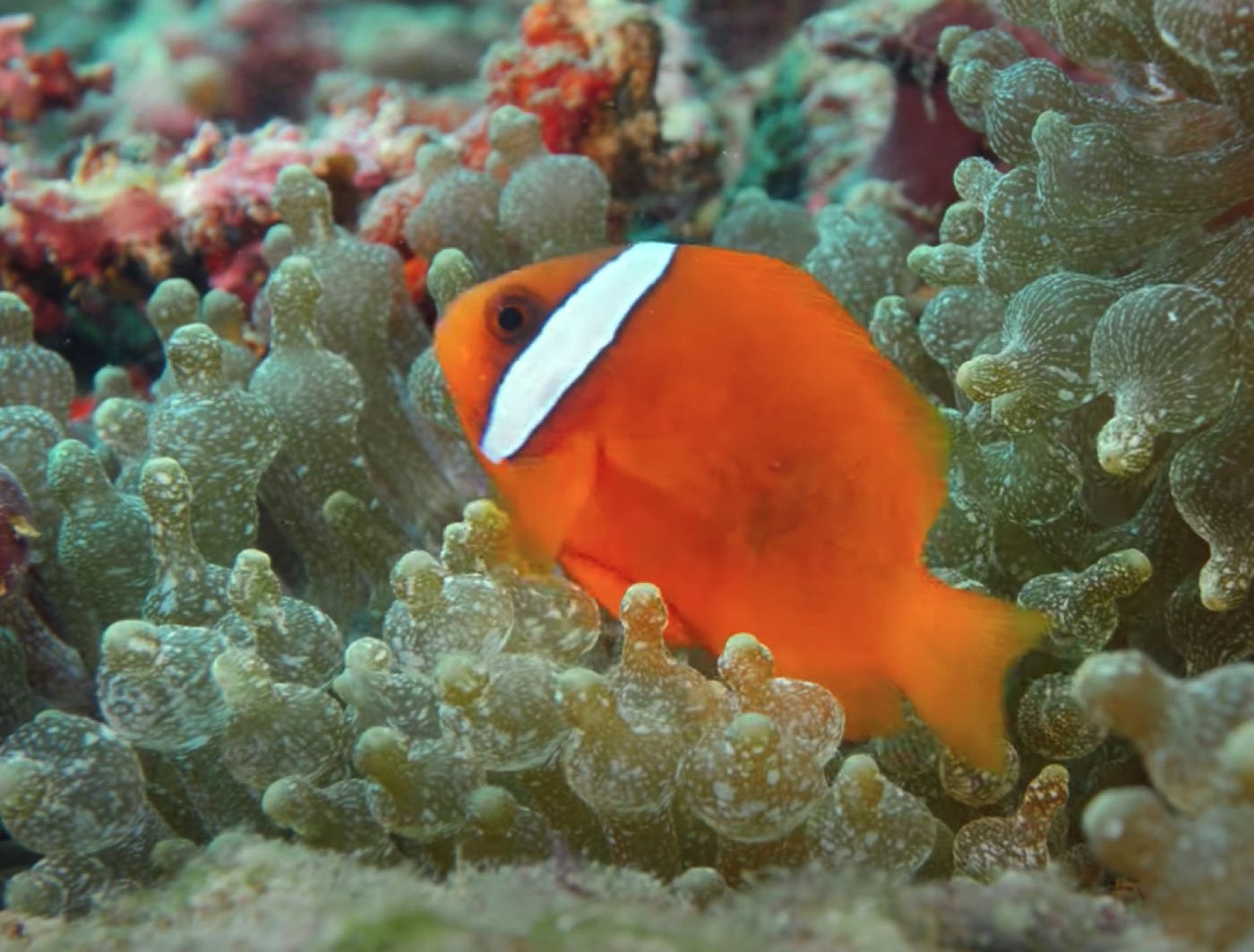
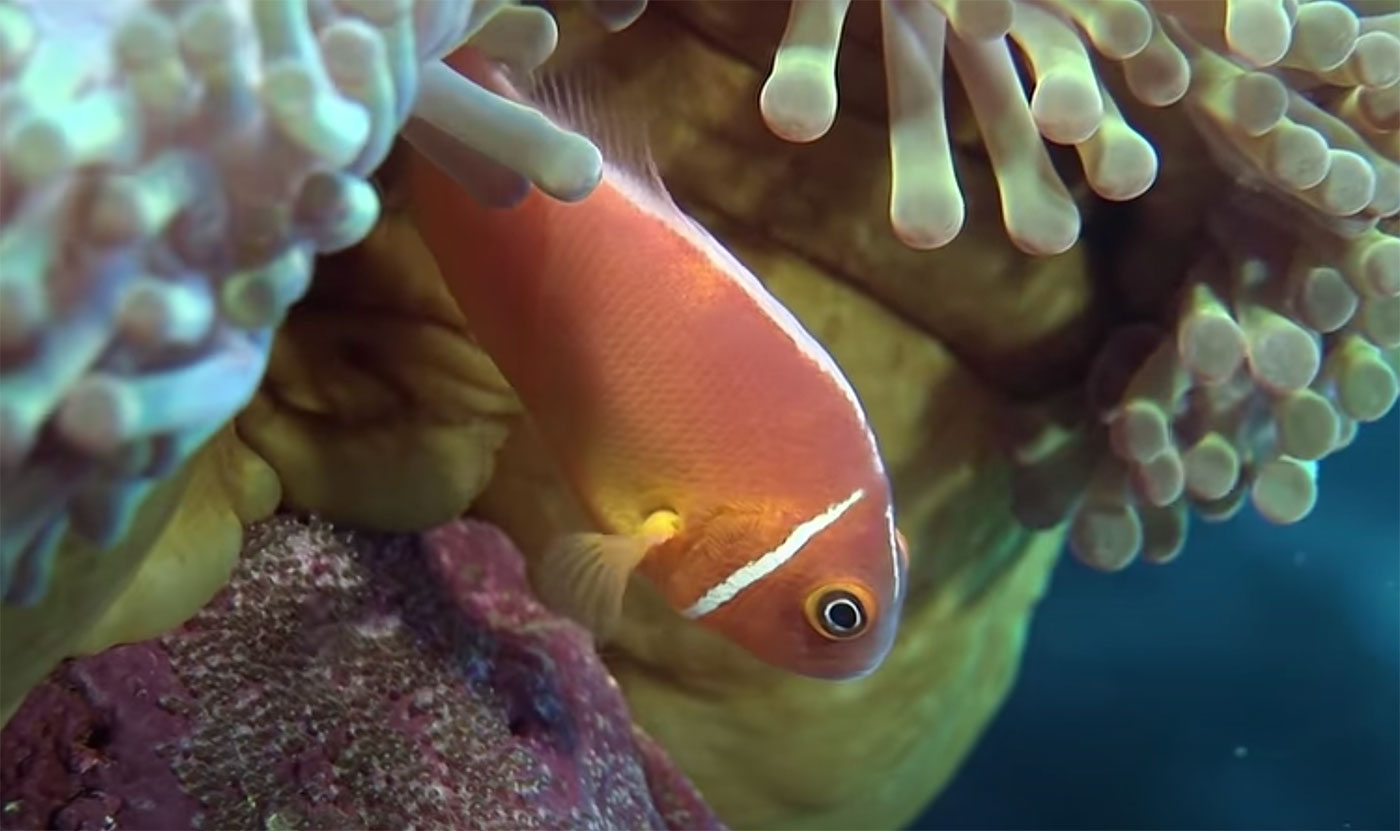
Clownfish may take Goniopora
spp. as surrogate hosts. This does not harm the coral in most cases.
Proud sponsor of this column
Clownfish
pestering or tearing up polyps
Some
authors, noting that clownfish have a tendency to choose Goniopora
polyps as a surrogate anemone, have suggested that the pestering
presence of clownfish was a possible cause for Goniopora's
demise in aquaria. In my opinion this is not so. I have heard the
occasional report of clownfish literally ripping off polyps, but
aside from such obviously destructive behavior, their mere
swishing among the polyps is not the cause of the gradual decline
seen in Goniopora, nor
is it stressful to their surrogate host. One of my own Gonioporas that I purchased from the late aquarist/marinelife
collector Eric Reichardt, lived for a couple of years in his
aquarium with a trio of clownfish. I bought it and the clownfish
when he had to tear his tank down. The Goniopora
is now several years older, four times larger in skeleton and
healthy as can be with its clownfish "pests." The notion
that clownfish housed with anemones might transfer damaging
anemone mucus to the Goniopora is interesting to test, but certainly is not a factor in
the common wasting syndrome typical of most Goniopora
stokesi in captivity.
Boring
Algae
Wilkens
(1990) discussed nitrate and the green boring alga Ostreobium
as causes for decline in the health of Goniopora.
While it is true that the proliferation of boring algae in the skeleton
can harm corals, aquarists are now more careful to maintain low nitrate
levels via plenum or turf filter systems, even bringing nitrate down to
the very low levels found on reefs. Despite this and in the absence of
the telltale green stain on the skeleton that characterizes Ostreobium,
Goniopora may still languish.
Theories about elevated phosphate levels in closed systems harming Goniopora
are also countered by the fact that aquarists who maintain low phosphate
now by using protein skimming, R.O. water, Phosphate adsorbing filter
media, and dosing kalkwasser still don't see a dramatic increase in
success with Goniopora stokesi.
Air
in the skeleton
Newly
imported specimens of Goniopora
may suffer from the effect of air trapped in the skeleton (B.
Carlson, pers comm), which may make them prone to infections. Goniopora
spp. are prone to "brown jelly" (protozoan) infections
(Wilkens, 1990), (Delbeek and Sprung, 1994). If these are not
treated immediately the coral is wiped out in a very short
period of time, normally one or two days. Another shipping
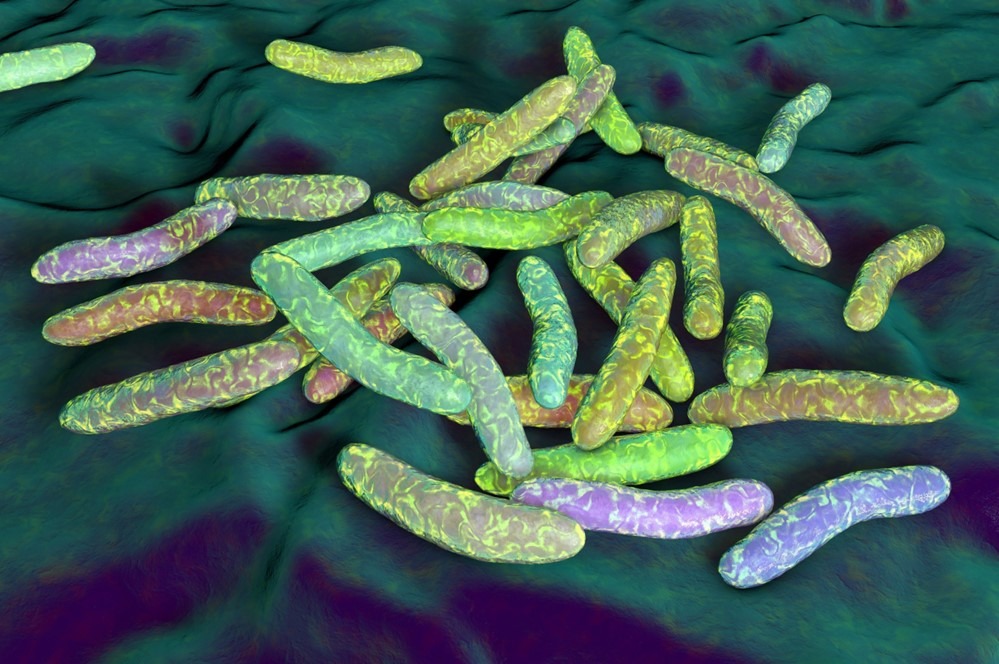
stress related disease I have seen is caused by bacteria. The
symptoms include strong retraction of the polyps and development
of a white film over portions of the colony, associated with
necrosis of the polyps and tissue. Flushing away the white film
reveals that this condition rapidly destroys the coral tissue,
causing it to separate from the skeleton and literally
disintegrate. The condition is often associated with a foul
smell and sometimes hydrogen sulfide production from the core of
the skeleton. In any case these causes of death are swift and
not related to the slow wasting condition.
Goniopora columna has numerous color forms and is very similar to
G. pandoraensis.
Food
Some
aquarists believe that Goniopora
stokesi simply needs more food in aquaria, that the symptoms of slow
decline are really a sign of starvation (Toonen, 1999a and Toonen,
2001). This natural supposition does not make sense when coupled with a
few other observations. First, the occasional specimen of Goniopora
stokesi thrives and grows for years without supplemental feeding, in
closed systems and in open systems. Other Goniopora
spp. also thrive without supplemental food aside from what is offered to
the fishes. The Goniopora sp.
at Waikiki, for example, is in an open system fed plankton-free well
water.If food were the
only issue, surely specimens maintained in heavily fed aquariums would
fare better than those maintained in sparsely fed aquariums. They
apparently don't.
Bleaching
induced starvation
When
Goniopora stokesi begins to
decline it bleaches and becomes sensitive to light: bright light makes
it bleach further and retract its tentacles (Sprung, 1999). The
tentacles furthermore become stumpy and degenerate. Though the
photosynthetically produced exudates from its symbiotic zooxanthellae is
a source of food, the light harms the coral for reasons I'll shortly
explain, and thus it cannot obtain sufficient food from its symbionts.
Gradual tissue recession results, partly due to starvation and partly
due to what I believe is the principle problem, oxidative stress damage.
This situation is a bit of a paradox: Starvation is not the cause of the
problem, but Goniopora stokesi apparently do slowly starve to death in aquariums.
Lighting
Improvements
in lighting systems offered a possible frontier for solving the Goniopora
mystery, but that frontier appears to have been crossed without solving
the problem. Now that we aquarists have finally got a handle of how and
why to maintain the alkalinity and calcium level, and now that we have
very good quality light sources, reports of success with all corals,
including the subjects of
this article, have increased. But if "the problem" with Gonioporastokesi
were just an issue of spectrum or intensity of the light, there wouldn't
still be a problem. Nevertheless, light plays a central role since, in
my opinion, the problem is a bleaching syndrome (Sprung, 1999a, Sprung
2001).
Goniopora pandoraensis forms upright branches in quiet lagoon reefs. It is among the easiest species to maintain.
Bacteria
and bleaching
While
bacteria can cause infections and tissue loss in corals, other
bacteria on corals have been associated with bleaching alone or
bleaching that leads to tissue loss. Rosenberg and Loya (1999)
describes how bleaching in a species of Oculina is caused by a species of bacteria, Vibrio shiloi. In Sprung (1999) I stated my opinion that the slow
wasting condition in Goniopora
stokesi may be a disease caused by a specific pathogenic
bacterium, as in the example of Oculina
shiloi. While I still believe that such a pathogen may
affect Goniopora spp.
sometimes, I do not believe it is the principle factor in the
slow wasting condition commonly observed in G.
stokesi in captivity. I still believe the principle factor
is a bleaching phenomenon, but I believe that it involves the
system used to detoxify oxygen free radicals generated during
photosynthesis. Before I elaborate on that I want to continue
for a moment on the topic of bacteria induced bleaching.
A
more recent study (Ben-Haim and Rosenberg, 2002) made the
connection between the effect observed in the Mediterranean and
one observed on tropical reefs in the common tropical
Indo-Pacific coral Pocillopora
damicornis collected from Zanzibar (see Delbeek, 2002 for
some additional comments regarding this paper).
The
fact that bacteria have been associated with coral bleaching in
some species of corals does not mean that bacteria are involved
with bleaching symptoms in Goniopora.
Anecdotal field observations, however, lead me to believe that
at least sometimes bacteria may be involved. Borneman (2002)
reports "random occasional
bleaching" mixed with healthy colonies in deep water
in Indonesia. Veron (1986) on page 248 shows photographs of such
mixed bleached and unbleached Goniopora
pandoraensis. Such patchy effects need to be examined to
determine whether their cause is environmental or due to the
effects of pathogens. The hypothesis must be tested.
What
needs to be done to understand whether bacteria may be involved
with the bleaching in Goniopora spp. is
to:
1.
Isolate a suspected pathogenic microorganism from an
"affected" Goniopora.(i.e., one having symptoms such as reduced polyp
expansion, bleaching, etc.)
2.
Grow this organism in pure culture.
3.
Inject the culture of this microorganism into a healthy host
(one that is free of the same pathogen and apparently healthy)
to determine if the symptoms are reproduced by such an
inoculation.
4.
Recover the suspected microorganism from the experimentally
infected host.
This
method is referred to in microbiology as applying Koch's
postulates and it is used to demonstrate the causative agent of
a disease.
A particularly beautiful Goniopora cf.
somaliensis. The red form of this species has been a popular import from Indonesia the past few years. Some forms have green, others magenta oral cones.
This Goniopora somaliensis maintained with strong currents developed acrospheres on the tentacle tips.
An
additional approach, which can be done in conjunction as a part
of the study, is to determine if antibiotic treatment reverses
the slow wasting condition. The authors of the papers on Oculina
and Pocillopora were able to block the disease with specific
antibiotics. Nevertheless, I suspect that the majority of
incidences of slow wasting in Goniopora
stokesi are not due to disease, but are instead related to
an inability to detoxify oxygen free-radicals in the captive
environment. The question is, why does this species almost
always seem to bleach in captivity?
Recently
there has been an increased interest in supplementation with
iron and, to a lesser extent, manganese in aquarium publications
(Holmes-Farley, 2002a and b). While some of the interest
surrounds the use of iron by plants in refugium filters, the
benefit to zooxanthellae and corals is less studied but implied
(Sprung 2002, Holmes-Farley 2002a). Holmes-Farley (2002b) offers
a review of scientific literature concerning experiments with
iron and corals, as well as studies of the iron content in
corals.
The
literature concerning iron and corals is not voluminous, but for plants
that is another story. Iron is essential for the synthesis of
chlorophyll, for the release of energy from sugars and starches
accomplished by light energy transferring compounds during
photosynthesis, and it is a component of several important enzymes.
These functions are crucial to corals that have symbiotic zooxanthellae.
Manganese
is a cofactor that is essential for chloroplast production and
chlorphyll formation, and it also participates and assists iron in
energy release from energy transferring molecules during photosynthesis.
Manganese is also involved in the uptake of nitrogen. Manganese also
activates important enzymes, and is involved with superoxide dismutase,
an enzyme that detoxifies oxygen free-radicals.
This
indicates a connection to the zooxanthellae and bleaching, which is
often a response to the over-production of oxygen free radicals (Warner,
et al., 1999, Downs, et al, 2002). Different forms of superoxide
dismutase have iron or manganese. There are other forms of superoxide
dismutase with other metal ions associated with them, but only iron and
manganese are likely to be limiting in closed aquariums (Shimek, 2002,
Fosså and Nilsen, 1996).
Goniopora minor photographed on a reef slope in the Solomon Islands.
Goniopora somaliensis
has numerous color forms, including this one.
A purple
Goniopora cf. tenuidens in one of the author's aquariums.
Newly imported
Goniopora cf. tenuidens with poorly expanding polyps.
The degenerated tentacles in this newly acquired purple
Goniopora cf. tenuidens make the polyps strongly resemble those of
Blastomussa merleti. Supplementation with iron and manganese reverses this condition.
One of the author's favorite corals to observe in nature,
Alveopora catalai lives on moderately deep reef slopes in lagoons. The polyps expand in the near motionless water.
As
is true in many endeavors, researchers in a field share interest in the
same areas simultaneously. I too have been exploring the role of iron in
zooxanthellae health, but I have taken the approach of including
manganese "in the mix" since the two elements are known to
work together to the benefit of plants. I have observed that an effect
of supplementing these two elements is the reversal of bleaching in
Corallimorpharia and large polyped corals such as various mussids and
the genus Trachyphyllia.
An
additional effect of the iron and manganese supplement on Goniopora
cf. tenuidens also is
demonstrable. All imported specimens of a purple and blue
variety of this species exhibit polyp contraction that soon
leads to gradual tissue recession and polyp loss. I have
observed dozens of specimens, all exhibiting the same condition
from the moment they were received. Intrigued by this I wondered
whether it might be possible to reverse the condition and keep
one of these colorful Gonioporas. I bought one at a local shop in Miami and placed it in
one of my aquariums, high up under metal halide light and in
moderate water flow. It is my experience that members of the
Poritidae that have strong purple or blue pigment tend to occur
in bright light situations on the reef. The Goniopora
cf. tenuidens remained closed for several days, but I noticed that the
addition of a supplement I prepared that contains iron and
manganese seemed to stimulate polyp expansion in the coral
within hours. When I discontinued the addition, after a few days
the polyps remained contracted for days. When I added the
supplement again they expanded within hours and stayed expanded
for a few days. When I added the supplement regularly the polyps
remained expanded and developed colorful tentacles. They have
not contracted now for over six months, and the colony is
growing.
A red form of
Goniopora stuchburyi in the Solomon Islands. This species has very small polyps.
The
anecdotal observation that iron and manganese seem to help alleviate
bleaching symptoms in G. tenuidens, and the literature concerning detoxification of oxygen
free-radicals suggests these elements are useful to the coral, but does
not necessarily suggest that Goniopora
stokesi has a special requirement for iron and manganese.
Proud sponsor of this column
I
am in the process of acquiring numerous specimens of Goniopora
stokesi for a long-term controlled study of the effect of
supplementing iron and manganese. The ultimate purpose of the
study is to either prove or disprove my hypothesis that the slow
wasting syndrome that affects this species in captivity is caused
by a bleaching phenomenon related to the loss of ability to
detoxify oxygen free-radicals. The first phase of the study is to
demonstrate:
1.
That iron and manganese limitation or supply affects Goniopora
stokesi.
2.
It prevents or reverses the slow wasting syndrome.
My
presentation at the upcoming IMAC 2003 conference in Chicago (see http://www.theimac.org/)
will focus on the study I am conducting and will offer some
additional details about the experimental design and new
observations made by that time.
Husbandry
Some
Husbandry considerations for commonly imported Goniopora
and Alveoporaspp.
I
offer here some guidelines for the care of the most commonly
imported varieties of Goniopora
and Alveopora. My
comments regarding feeding refer to the types of food that an
aquarist typically might offer, such as brine shrimp, brine shrimp
nauplii, copepods, or pulverized foods. In this article I am not
taking into consideration the fact that the corals discussed may
feed on invertebrate larvae produced within the tank or on
phytoplankton (see Toonen, 1999, Toonen, 2001, and Sprung, 1999b).
I know that these corals are feeding to supplement the
photosynthetic products of their symbiotic zooxanthellae, but my
comments here refer to the need to add supplemental food aside
from the food offered to fishes housed in the aquarium.
Branchy
Goniopora and Alveopora.
In
Sprung (1999a) I described a set up I created initially as a refugium/Jaubert
plenum filter system, which has turned out to be quite a nice place
for growing branched Goniopora and Alveopora.
For Alveopora and branchy Goniopora
species (for example, G.
pandoraensis, G. eclipsensis, and G. columna)
that look like Alveopora,
moderate to relatively low light intensity and moderate to low water
flow are best. In the low flow, diffuse light aquarium with shallow
water I have been able to grow branchy Goniopora
pandoraensis and Alveopora
gigas for several years. They extend their daisy-like polyps
beautifully. These corals simply would not survive in the typical
"more-flow, more-light" systems in vogue today among reef
keepers. I have not seen any of the above-mentioned species take food
offered to them, whether live or particulate.
Placement
Siegel
(2002) suggests that success with Alveopora
may require placement on the bottom substrate. While it is true that
such a placement is generally good for many members of this genus, it
is not the substrate itself that benefits the coral. Rather it is the
less intense and less direct light, as well as lower water flow. I
have maintained Alveopora
spp. on the substrate and attached to rock, but always with indirect
light and moderate to low water flow. Toonen (1999) discusses
occasional success with Goniopora
stokesi in refugium aquariums. As such aquariums typically also
include various algae, it may be that the aquarist is supplementing
with iron and manganese for the algae and benefiting the coral, or
that exudates from the algae are chelating the iron and manganese in
the water and maintaining adequate levels for the coral. The algae
also give off spores that the coral may feed on.
Alveopora
japonica
This
small species is popular with aquarists in Japan where it is readily
available. Colonies are typically small spheres, about one or two
inches in diameter, but with the polyps extended these are about three
or four inches across. They come in fantastic combinations of green,
white, and gray. Alveopora
japonica is a bit more sensitive to high temperatures than other Alveopora
species. It should be maintained below 80 degrees F., with moderate to
low light levels. It tolerates strong water motion but shows best in
low to moderate flow. It should not be placed on the substrate because
sand-shifting creatures may bury it. This species does not take food
offered.
Goniopora
fruticosa,
This
species is occasionally harvested in Indonesia for aquariums,
mostly unintentionally, as small colonies attached to another
organism. Goniopora
fruticosa, has chocolate brown polyps with white oral
cones. The polyps don't extend quite as much as in other Goniopora
spp. I saw this species in clear water on reef slopes in the
Solomon Islands. Colonies are encrusting with numerous short
upright branches, and may cover large surface areas. They were
not on exposed reef fronts, but instead occurred on more
protected slopes that are at about a 45 degree angle with
respect to the surface. The currents were slight to moderate
in this habitat. In captivity they tolerate a wide range of
light intensity. This species does take small zooplankton.
Goniopora lobata has elongate polyps, like
G. stokesi.
Alveopora gigas growing in one of the author's aquariums. Note that the coral has grown to the water's surface.
Goniopora
cf. somaliensis
The
past few years a very beautiful bright red species, Goniopora
cf. somaliensis has
been imported from Indonesia with some regularity, and it is
popular owing to the fact that it is among the hardiest
species. It fares well both in low light low flow aquariums
and bright light strong flow aquariums. With strong water flow
and stronger light they develop longer, fatter polyps with
stringy tentacles and acrospheres on the tips of the
tentacles. This species does take small zooplankton.
Goniopora
cf. tenuidens
This
species has been imported frequently in the past year. It is
purple with bluish tentacle tips and pale cream colored oral
cones. Gonioporatenuidens
is known to have other color combinations, and the species I
am discussing may in fact be another species, though it
matches no other in Veron (2000). This species fares well
under strong illumination and moderate water flow, but it
appears to require supplementation with iron and manganese. I
have not observed it taking any plankton. The care of this
species is essentially the same as for G.
lobata, G. minor, and G. djiboutiensis,
which are similar in appearance.
Goniopora
stokesi
Goniopora stokesi
occurs mainly in turbid lagoons in shallow water on coral
rubble or soft substrates. It also occurs on reefs and in deep
water. With its habitat preferences one might expect it to be
very hardy. Nevertheless, it is considered delicate by most
aquarists. Aquariums for keeping this species should consider
the most common habitat: a horizontal substrate, with
moderately strong light, though somewhat diffused by the
turbidity in the water. The water flow is influenced by tidal
currents, so it is periodically strong but more often slight.
As I hypothesize in this article, the husbandry of this
species may require extra attention to the supplementation of
iron and manganese. I have seen Goniopora
stokesi feed on live brine shrimp and other plankton, but
I believe it can be maintained without extra feeding.
Goniopora stokesi: The author believes that long-term wasting in this coral can be attributed to oxidative stress induced bleaching, and that it can be prevented with iron and manganese supplements that assist in the detoxification of oxygen free-radicals. This hypothesis is being tested.
Bibliography:
Ates,
R. 1997. Goniopora coral -
What's Missing In Our Aquariums For Their Survival? Aquarium Frontiers. March/April
Atkinson,
M. and C. Bingman. 1999. The Composition of Several Synthetic Seawater
Mixes. March 1999 Aquarium
Frontiers On-line.
Atkinson,
M.J. , Carlson, B. , and G. L. Crow1995. Coral growth in high-nutrient, low-pH seawater: a case
study of corals cultured at the Waikiki Aquarium, Honolulu, Hawaii Coral
Reefs Volume 14, Issue 4, pp 215-223
Ben-Haim,
Y. and E. Rosenberg. 2002A novel Vibrio sp.
pathogen of the coral Pocilloporadamicornis. Marine Biology
141: 47-55.
Borneman,
2002. Do You Know Where Your Corals Are
Coming From?Ecological
Information for Aquarists from Coral Collection Areas in Indonesia. Advanced
Aquarists Online Magazine.
Vol 1, Issue 3.
Delbeek
and Sprung, 1994. The Reef
Aquarium Volume One. Ricordea Publishing, Coconut Grove, FL.
Delbeek
and Sprung, 1997. The Reef
Aquarium Volume Two. Ricordea Publishing, Coconut Grove, FL.
Fosså,
S. and A. Nilsen (1996) The
Modern Coral Reef Aquarium Volume 1. Birgit Schmettkamp Verlag.
Holmes-Farley,
R. 2002a. Iron in a Reef Tank. Advanced
Aquarists Online Magazine. Vol 1, Issue 8.
Holmes-Farley,
R. 2002b. Iron A Look at Organisms other than Macroalgae. Advanced Aquarists Online Magazine. Vol 1, Issue 10.
Rosenberg,
E. and Y. Loya. 1999. Vibrio
Shiloi is the Etiological (Causative) Agent of Oculina
Patagonica Bleaching: General Implications. Reef Encounter.
Shimek,
R. L. 2002. It's (In) The Water. Reefkeeping.Com. Volume 1. Number 1.
February, 2002.
Sprung,
J. 1999. Corals, A Quick
Reference Guide. Ricordea Publishing, Coconut Grove, FL.
Sprung,
J. 1999a Is there really something special about Goniopora, Alveopora and Heliofungia?"
Marine Fish and Reef USA .
Sprung,
J. 1999b. Corals: A Quick
Reference Guide. Ricordea Publishing. Coconut Grove., FL.
Sprung,
J. 2001. Coral Bleaching. Marine
Fish and Reef USA
Sprung,
J. 2002. Algae: A Problem Solver
Guide. Ricordea Publishing, Coconut Grove, FL.
Toren
A., Laundau L., Kushmaro A, Loya Y, and E. Rosenberg (1998) Effect of
Temperature on the adhesion of Vibrio AK-1 to Oculina patagonica and coral bleaching. Appl. Environ. Microbiol. 64: 1379 - 1384.
Toonen,
Rob. 2001. Goniopora. FAMA 24(6): 142-158
Veron,
J.E.N. 2000. Corals of The World.
Vol 3. Australian Institute of Marine Science.