The marine
aquarium opens up an amazing world to the amateur naturalist. Not only
does the aquarist have an opportunity to observe a wide array of
interesting invertebrates and fishes, they can also witness some of
the fascinating symbiotic relationships that occur between these
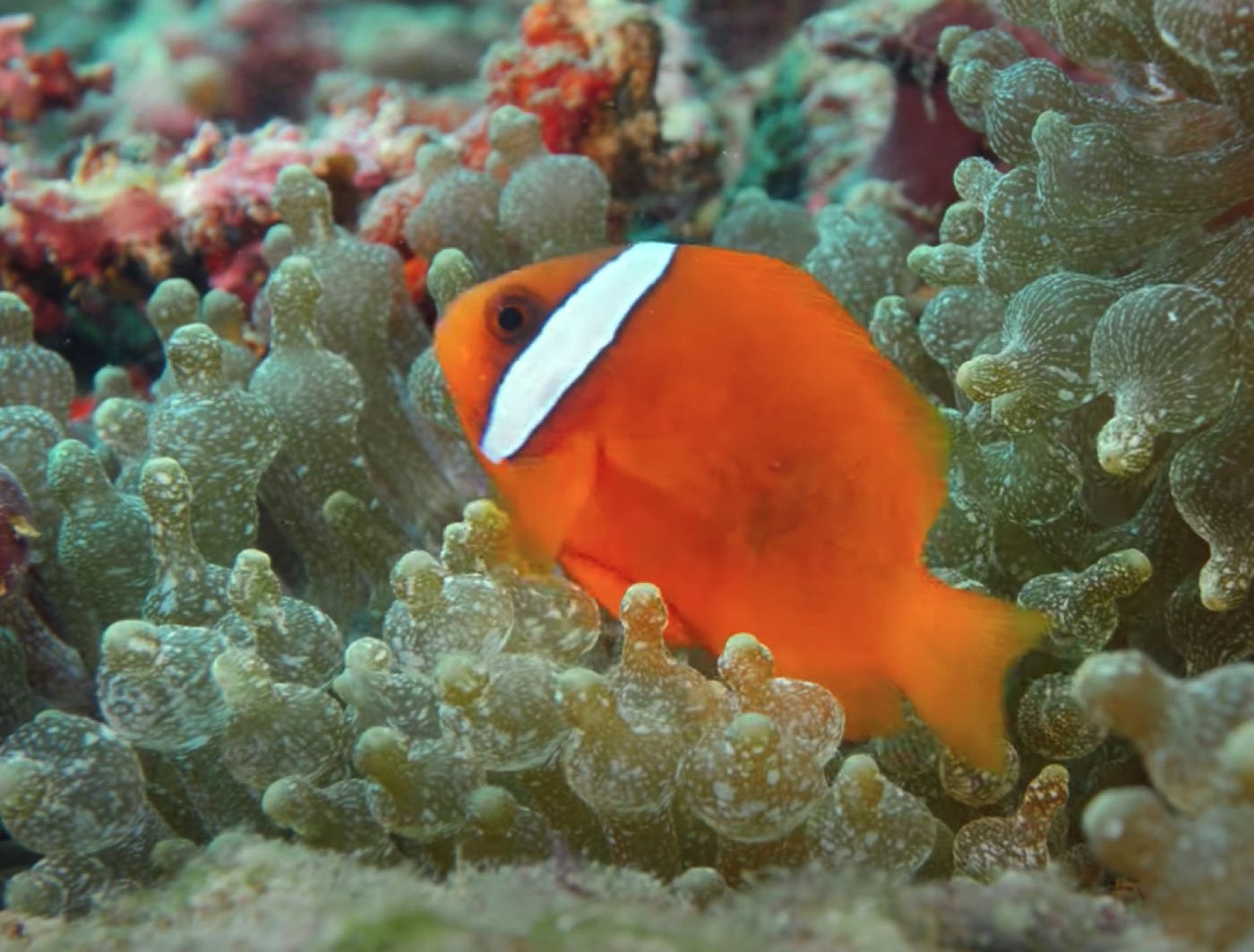
animals on the coral reef. For example, we are all familiar with the
sea anemone-anemonefish association. There are many marine aquarists
that were drawn into the aquarium hobby as a result of their
fascination with this cnidarian-fish association. But there is another
invertebrate-fish relationship that I think is even more amazing than
this one. It involves a number of goby genera and certain snapping
shrimps (family Alpheidae).
The
shrimpgoby-snapping shrimp relationship is a mutualistic one –
that is, it’s an association where both members benefit. The
primary benefit for the goby is that the burrow provides a
sanctuary for the otherwise vulnerable fish. In exchange for
refuge, the shrimpgobies act as "seeing-eye" fish for
their relatively poor-sighted crustacean partners (note: some
crustacean experts have suggested that these shrimp actually see
quite well, even so their visual acuity is not as good as that of
the goby). As the shrimp keeps house or feeds just outside of the
burrow, the goby will sit near the burrow’s entrance and
“stand guard” (it will also feed and interact with
conspecifics at this time as well). The tidy little crustacean
moves freely in and out of its refuge, but when it leaves the
burrow it keeps in contact with the vigilant goby. It does this by
placing one of its antennae on the fish. (This antennal contact is
the critical line of communication between the two animals.)
Proud sponsor of this column
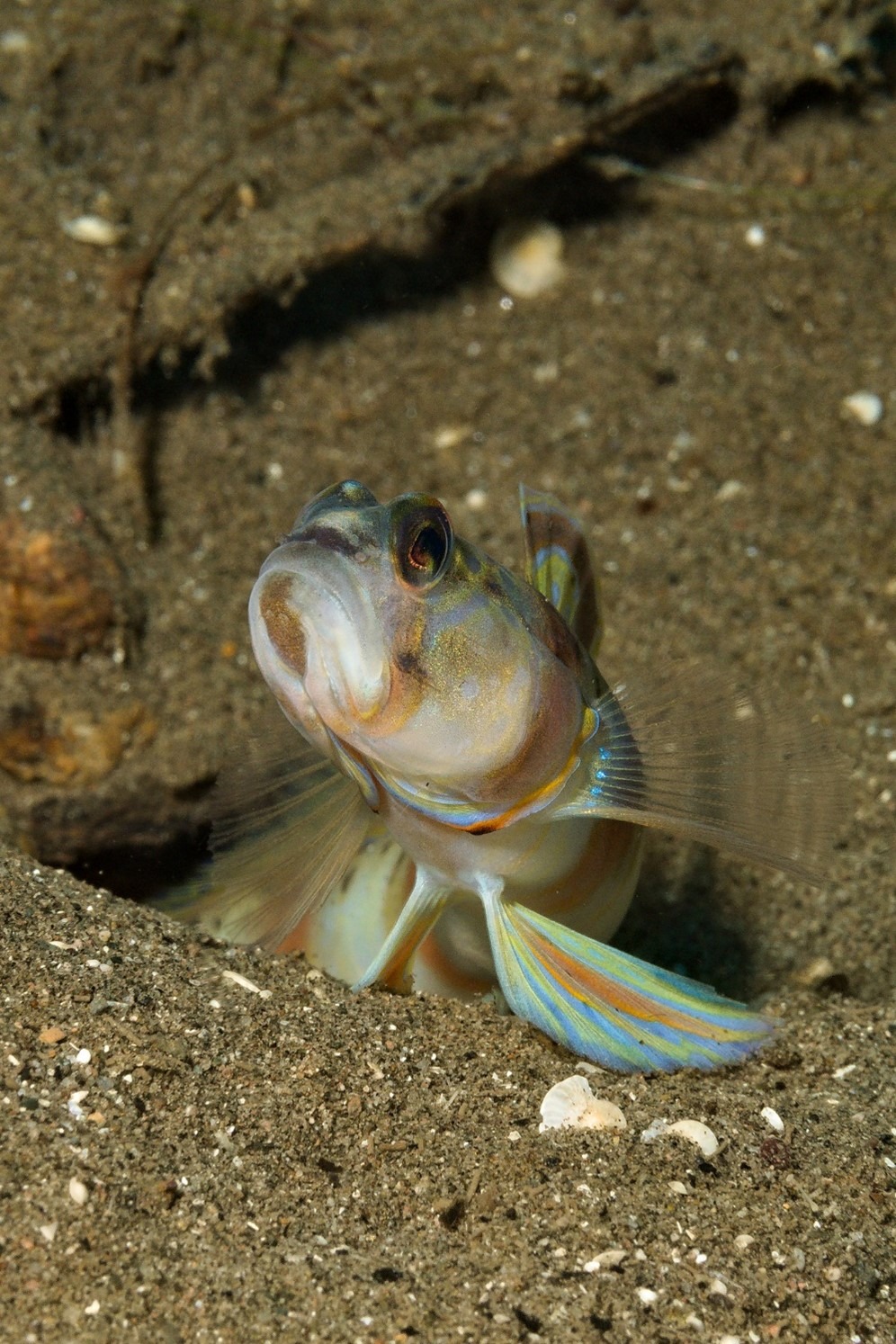
The
whiteray shrimpgoby (Stonigobiops sp.) is a stunning
fish that makes an fascinating addition to the reef aquarium.
This individual was photographed off Oshima Island, Japan, in
30 m of water.
When a
predatory fish approaches, the goby will rapidly flick its tail,
warning the shrimp of impending danger. If the goby flicks its tail
once the shrimp may not respond, but if the goby executes a series
of flicks the shrimp it will move quickly back into its burrow. If
the predator comes within a critical distance, the goby will also
dart (headfirst) into its hiding place. (For a more extensive survey
of shrimpgoby biology and behavior go to www.coralrealm.com
)
Genus Stonogobiops
The
members of the genus Stonogobiops are some of the most attractive gobies available to
marine aquarists. There are six species in the genus, one of which
has yet to be formally described – this Stonogobiops sp. is
the subject of this article. Only three of the Stonogobiops spp.
show-up in aquarium stores with any degree of regularity, and one of
these is commonly seen. Two of these species are very similar in
color, with alternating white and dark brown to black bands on the
body and a yellow head. The three other members of the genus that
are not (or rarely) encountered in the marine aquarium trade are:
the Dracula shrimpgoby (Stonogobiops dracula) from the
Maldives,Medon's
shrimpgoby (Stonogobiops medon) fromthe
Marquesas Islands, and the fivebanded shrimpgoby (S.
pentafasciata) that was recently described from Japan.
Unlike the other
shrimpgobies, which spend most of their time resting on the substrate,
most of the highfin shrimpgobies scull in the water column from 1 to 36
cm (0.4 to 14 in.) over their burrow entrance. Most of these fishes also
associate with Randall's shrimp (Alpheus randalli). However, in the Seychelles, S. dracula also lives in association with a shrimp tentatively
identified as A. djiboutensis and
in Japan, Stonogobiops
xanthorhinica will associate with A.
bellulus (Polunin and Lubbock 1977, Yangagisawa 1982). In the
aquarium, these fishes have also been known to pair-up with other
species of commensal snapping shrimp. The Stonogobiops spp. tend
to be found at moderate depths 14 to 43 m (45 to 140 feet) on sloping,
sandy bottoms at the base of fringing reefs.
The Whiteray Shrimpgoby
One of
the most spectacular members of the genus Stonogobiops
is the whiteray shrimpgoby (Stonogobiops
sp.). This beautiful fish has a long, white first dorsal
spine. It also has bright or rusty orange longitudinal lines on the
flanks that are broken into elongate spots on the head and opercula.
This beautiful goby attains a maximum length of around 5 cm (2.0
in.). The distribution of this fish is not well known, but it has
been reported from southern Japan south to the Great Barrier Reef.
It is also collected in Sri Lanka. Even though it is wide ranging
and well known to ichthyologists, it has yet to be scientifically
described and ascribed a scientific name.
Proud sponsor of this column
The
yellownose shrimpgoby (Stonigobiops xanthorhinica) and
its snapping shrimp partner, Alpheus randalli. This species is
uncommon in the aquarium trade.
The
whiteray shrimpgoby can be found on sand or mixed sand-rubble
slopes, where it is most often found at depths in excess of 30 m (98
ft.). It will hover in the water column near its hole, but will also
spend a considerable amount of time resting on the bottom near the
entrance of its burrow. The whiteray shrimpgoby is very shy and as a
result, is very difficult to photograph. The fact that it occurs at
greater depths makes getting good photos even a greater challenge.
While you can “wait out” many of the shallow water shrimpgobies,
there is no time to get the whiteray to habituate to your presence
at a depth of 30 m (98 ft.) or more. The only in-situ shots that I
have of this fish were taken of a “friendly” individual shown to
me off one of the Izu Islands, Japan. (I was able to take two shots
before the fish darted into its burrow.)
The whiteray shrimp goby is often observed singly, but is
occasionally seen in pairs (like many of the shrimpgobies, pairs may
occupy the same burrow during the spawning season). This shrimpgoby
is usually found with Randall’s snapping shrimp (A. randalli)
(some have suggested that what appears to be a color variant of A.
randalli may actually be a distinct species). Fortunately for
the aquarist, this goby is often available with its shrimp partner,
which makes for a remarkable display in the home aquarium.
Keeping the Whiteray
Shrimpgoby
It is critical that you
carefully acclimate the whiteray shrimpgoby. It is not uncommon for
this species to hide for days or even weeks before making an
appearance. The first individual I ever kept hid for three weeks. In
fact, I thought it was dead. Then one night, just before the tank
lights turned off, I saw its head sticking out of a newly formed
burrow. The shrimp and goby had found one another and the former had
created a small home under live rock on one side of the tank. It
took weeks before the fish was brave enough to come out when I was
near the aquarium. Because it was so reclusive, the goby had lost a
lot of weight. For the next month, I had to make a concerted effort
to get food past its hungry tankmates, down to the corner where it
lived. In time, the goby became a more aggressive feeder, making
more frequent forays into the water column to snatch passing food
items.
The
most common member of the genus is the blackray shrimpgoby (Stonogobiops
nematodes). The husbandry requirements of this species are
very similar to the whiteray shrimpgoby.
A
captive whiteray shrimpgoby. Note the slight differences in
color pattern between this individual (that was reportedly
collected in the Indian Ocean) and the individual from Japan
shown above.
In contrast, I have also had
individuals that were very bold. One such individual “hooked-up”
with its shrimp and was making feeding forays the second day after
it had been introduced to the tank. But, this individual represents
the exception, not the rule for this species.
One way to facilitate
whiteray goby acclimation is to avoid keeping it with aggressive
tankmates. If the aquarium is home to pugnacious damsels, dottybacks,
larger jawfishes, hawkfishes, pygmy angels, aggressive wrasses
(e.g., larger Bodianus spp., Pseudocheilinus spp., andThalassoma spp.), sand perches, and larger, scrappier
shrimpgobies (e.g., Cryptocentrus spp.) this fish is less
likely to adjust to its new home. That said, once a whiteray has
acclimated to a tank, it is possible to introduce fishes that are
more bellicose (I would still stay away from overly aggressive
species and predatory species that might eat them!). They will often
defend their burrow by jaw gaping at an opponent or will simply dart
into their refuge if harassed. Although good at aggressive bluffing,
these diminutive fishes may not get enough to eat if incessantly
hassled by pugnacious tankmates. The Stonogobiops have been
known to get evicted from their burrows by larger jawfishes, while
substrate-disturbing species, like goatfishes, convict worm gobies,
and sleeper gobies may collapse their shrimp partner’s underground
architecture.
Of course, the
whiteray is potential prey for piscivorous fishes, including large
comets (Calloplesiops spp.), and may fall victim to fish-eating
invertebrates, like carpet sea anemones (Stichodactyla spp.),
crabs, and green brittle stars (Ophiarachna incrassata). (It is
more likely to be preyed upon when it is initially added to the aquarium
and has yet to find a crustacean partner.)
This goby is best
kept with species that exhibit less interspecific aggression. Good Stonogobiops
tankmates include anthias (Pseudanthias spp. and Serranocirrhitus
latus), assessors (Assessor spp.), Chromis (Chromis spp.), more placid
demoiselles (e.g., Chrysiptera hemicyanea, C. parasema,
and C. springeri), fairy wrasses (Cirrhilabrus
spp.), flasher wrasses (Paracheilinus
spp.), leopard wrasses (Macropharyngodon
spp.), dragonets, clown gobies (Gobiodon
spp.), Amblygobius
gobies, fire gobies (Nemateleotris
spp.), and dart gobies (Ptereleotris
spp.). If housed in a larger tank, it is possible to keep the whiteray
shrimpgoby with larger species like butterflyfishes, angelfishes, and
surgeonfishes. Fortunately, these reef fishes will typically ignore this
goby, but their presence may make an unacclimated Stonogobiops less
likely to emerge from its burrow to feed. The only requirement is that
the goby is acclimated to a larger tank before these larger tankmates
are added.
It is a
good idea to keep the whiteray shrimpgoby in a tank that contains
small fishes that spend their time feeding in the water column. The
presence of these active fishes can help shy fish, like the Stonogobiops
spp., “feel” more secure. These tankmates, which are often
referred to as “dither fish,” will encourage these gobies to
leave their hiding place and investigate their new world. A newly
introduced whiteray is also prone to jumping out of an open aquarium
when the lights are extinguished or if it’s being bullied. Cover
the tank until the fish acclimates and/or provide a night light. Stonogobiops
spp. have also been known to bury under fine sand if startled.
The
whiteray shrimpgoby, and its congeners, are a wonderful choice for a
nano-reef. They do not require much space (I have kept them in tanks
as small as 5 gallons) and are easier to observe in a diminutive
aquarium. This goby is also more likely to acclimate if kept on its
own (i.e., without potentially bothersome fish tankmates). One thing
I should point out is that in a tank without dither fish, it may
take the Stonogobiops a little longer to overcome its initial
shyness. But once it does, it will be quite “happy” not having
to compete with more aggressive feeders.
A detailed shot of the head of
the same individual. Note the black patch of pigment on its
"chin."
Proud
sponsor of this column
More than one whiteray
shrimpgoby can be housed in the same tank. For example, I am
currently keeping two of these gobies in a 105 gallon Oceanic
aquarium (the footprint is 18 x48 inches). In this reef aquarium, the snapping shrimp
have constructed burrows on opposite ends of the aquarium.
(Note: when I added the second goby-shrimp pair, I carefully
introduced them to the end of the aquarium, opposite to where
the other whiteray had established its burrow). Because these
gobies rarely move more than 10 inches from their burrows, I
have yet to see them interact. Because of their limited home
ranges, I believe that I could get away with slipping another
whiteray shrimpgoby into this reef tank.
Fighting
in the Stonogobiops spp. consists of mouth-gaping
displays, chasing and biting. Sometimes when they bite each
other, or other fish species for that matter, they will
tenaciously hold their opponent. For example, on one occasion I
had to remove a S. nematodes from the jaw of a larger pinkspotted shrimp goby (Cryptocentrusleptocephalus). I
assume that the larger goby threatened its smaller relative and
the latter responded by clamping on with its jaws.
Placing
the whiteray shrimpgoby tank in a low traffic area will also
facilitate acclimation. For example, it is best not to house a
whiteray shrimpgoby in an aquarium in the lobby of a dentist
office, where there is a lot of human activity, including kids
tapping on the glass. In this venue, the whiteray is likely to
hide constantly, and as a result, it will not get enough to eat.
Another
Stonogobiops husbandry prerequisite is to feed this fish
at least once a day. I feed my whiteray shrimpgobies twice a
day. I feed frozen mysid shrimp, Omega One flake food, and a
wonderful food called Cyclop-eeze®. The latter is a very
nutritious food (e.g., high HUFA and protein content), it
remains in suspension longer, and my fish love it!(Ask your retailer to get it by calling
800-521-6258 or by going to www.freezerbar.com
– they do not sell direct to hobbyists!). This gives
smaller zooplanktivores more time to pick the food particles out
of the water column. When you feed them, it is best to place the
food in the out flow of a water pump, so that it moves through
the water column like their natural prey.
That
ends our examination of the fascinating whiteray shrimpgoby. I
hope that those of you that have a passive community tank will
seek this fish and its shrimp associate out and give it a try!
They make fascinating pets. Happy fish watching!